
Under the European Market Infrastructure Regulation (EMIR), all counterparties are required to report details of any derivative contract they have concluded, or which the counterparty has modified or terminated. Due to Brexit, the EU regulations have been onshored as UK EMIR under the European Union (Withdrawal) Act 2018. On this page, EMIR reporting refers to both EU and UK unless otherwise specified.
European Market Infrastructure Regulation
Monitoring systemic risk
Regulate OTC derivatives transactions in European Union
All counterparties are required to report details of any derivative contract they have entered, modified or terminated.

The original regime remains in force for EU member states. It continues to evolve under ESMA.

The regime was onshored into UK regulation. Over time it will diverge from the EU version as the FCA updates it.
Read more about the difference between EU and UK EMIR
Reporting all derivative contracts - both over-the-counter (OTC) and exchange-traded;
Clearing eligible OTC derivatives;
Measures to reduce counterparty credit risk and operational risk for bilaterally cleared OTC derivatives;
Common rules for central counterparties (CCPs) and for Trade Repositories (TRs); and
Rules on the establishment of interoperability between CCPs.
The regime requires all counterparties and CCPs to report details of any derivative contract (with the underlying asset classes – interest rate, FX, credit, equities and commodities) they have concluded and of any modification or termination to TRs.
EMIR RECOGNISES 2 TYPES OF COUNTERPARTIES TO A CONTRACT:
Financial Counterparties (FC) – investment firms, fund managers, banks, insurers etc.; and
Non-Financial Counterparties (NFC) – entities not qualified as a financial counterparty, including those not involved in financial services.
EACH COUNTERPARTY MUST REPORT THEIR LEG OF A TRADE UNLESS:
one counterparty agrees to report on behalf of another counterparty by prior agreement;
a counterparty to a trade has delegated the reporting obligation to a third-party; or
a trade is executed between a FC and a NFC- where the FC will be responsible and legally liable for reporting on behalf of itself and the NFC-.
Where one counterparty reports on behalf of another counterparty, or a third-party reports a trade on behalf of one or both counterparties, the report details will include the full set of details as required by each counterparty.
trade reporting
Financial Counterparties (FC) and Non-Financial Counterparties (NFC) trading in derivatives must report details of all derivatives trades via a TR. This includes all the details of trades and any event thereafter that affects the valuation or the terms of the trade. It also includes identification of the country of the counterparty (country of incorporation for legal entities, country of residence for natural persons).
Any derivative contract is required to be reported under EMIR reporting requirements, and includes:
trade reporting
Financial Counterparties (FC) and Non-Financial Counterparties (NFC) trading in derivatives must report details of all derivatives trades via a TR. This includes all the details of trades and any event thereafter that affects the valuation or the terms of the trade. It also includes identification of the country of the counterparty (country of incorporation for legal entities, country of residence for natural persons).
Any derivative contract is required to be reported under EMIR reporting requirements, and includes:
Reports are required to be submitted to a registered TR no later than one working day after the trade has been made (T+1).

TRAction can provide you with delegated reporting solutions in accordance with the requirements outlined above. We help you understand your trade reporting obligations and completely simplify your process. Depending on how our client’s system works, TRAction has 3 different methods ready to be tailored to our clients’ needs.
If you want to learn about our services, please get in touch with us.
Stay in the know with
Check out our blog for the latest updates on regulatory changes and issues regarding trade/transaction reporting under the EMIR reporting regime.
Pricing packages
We charge a combination of an account management fee and a cost per transaction/position. Contact us for a quote, or view our pricing page for more information.
TRAction has outlined the key differences between EMIR and MiFIR. Our team has also pointed out some of the issues that investment firms need to be aware of under the regimes, so that you can stay compliant with the trade/transaction reporting requirements. Read more.
We’ve identified the most common errors (for both EU and UK) in the data we receive from our clients:
One year on from the final phase of EMIR Refit go-live (EU April 2024, UK September 2024), the derivatives industry seems to have settled after the changes, but not without some surprises.
The switch from CSV to XML proved to be smoother than expected. However, there are still issues with UPIs, lifecycle event errors and pairing and matching, which appeared to cause TRs some teething issues.
In our article, we discuss:
As a delegated reporting service provider, TRAction is asked a lot of questions regarding EMIR, MiFIR and SFTR requirements. That’s why our team has put together some of our most frequently asked questions, so that you can learn how to seamlessly report transactions under multiple regimes. Read more.
We all know that meeting all the requisite trade/transaction reporting obligations for EMIR, MiFID II/MiFIR and SFTR can pose a considerable cost to an investment firm. While the regulatory burden is not going to disappear, it can be minimised by outsourcing and choosing the most cost-effective and efficient option for you. Read more.
While trade and transaction reporting rules allow firms to delegate their obligations to a third party, they remain ultimately responsible for ensuring the details of their transactions are reported correctly and accurately under Art 9(1) of EMIR & Art 26(7) of MiFIR. Read more.
Since the EU & UK EMIR Refit trade reporting regime updates in April and September 2024, many firms have been asking how to deal with the backloading of collateral and valuation information.
In this article, we unpack:
ESMA asks for any collateral transferred, between two counterparties to a transaction, to be reported in EMIR Trade Reports. Collateral can be reported on a per position basis or on a portfolio basis. Read more.
Since the EMIR Refit updates in 2024, many firms have faced challenges creating and maintaining consistent client identifiers for 'Counterparty 2' clients.
Reasons for duplication and reconciliation issues include:
Click here to read our article, which breaks down the requirements, how to structure Unique Client IDs, and how TRAction helps firms link their client records correctly.
There are a number of regimes including EMIR, MiFID II/MiFIR, SFTR and Best Execution, all of which affect Investment Firms (IFs) in different ways. Read more to see the regulatory reporting required by IFs.
Each Investment Firm (IF) is required to make a quarterly assessment on its previous 6 months’ data to determine if it qualifies as a Systematic Internaliser (SI). Where an IF is classified as a SI, it will be obliged to meet the pre- and post-trade transparency requirements. Read more.
Interest Rate Derivatives (IRDs) are one of the most widely traded instruments globally. IRDs are vital for managing interest rate exposure, yet complex to report correctly.
Learn more about the history of IRDs, their structure, how they work, and key information about reporting them.
There are certain fields within the regimes of EMIR, MiFIR, SFTR, ASIC, MAS and Canada, which require populating with an LEI.
Check out our article, where we detail regimes and LEI fields for population and validation.
EMIR Trade Repositories (TRs) have now started giving reporting entities feedback on their pairing and matching status in the form of an end of day report in respect of the new EMIR Refit.
TRAction explores the process undertaken by the LSEG Regulatory Reporting TR.
Learn more about pairing and matching and the relevant fields they need to match exactly.
When there is a fund and fund manager involved in derivatives trades, the fund manager is generally responsible for trade reporting for the transactions entered into by the fund. But what happens if one is inside the European Union and the other one outside the EU? For instance, if a fund is registered in the Cayman Islands but the fund manager is in Ireland, what happens then? Click here to read more.
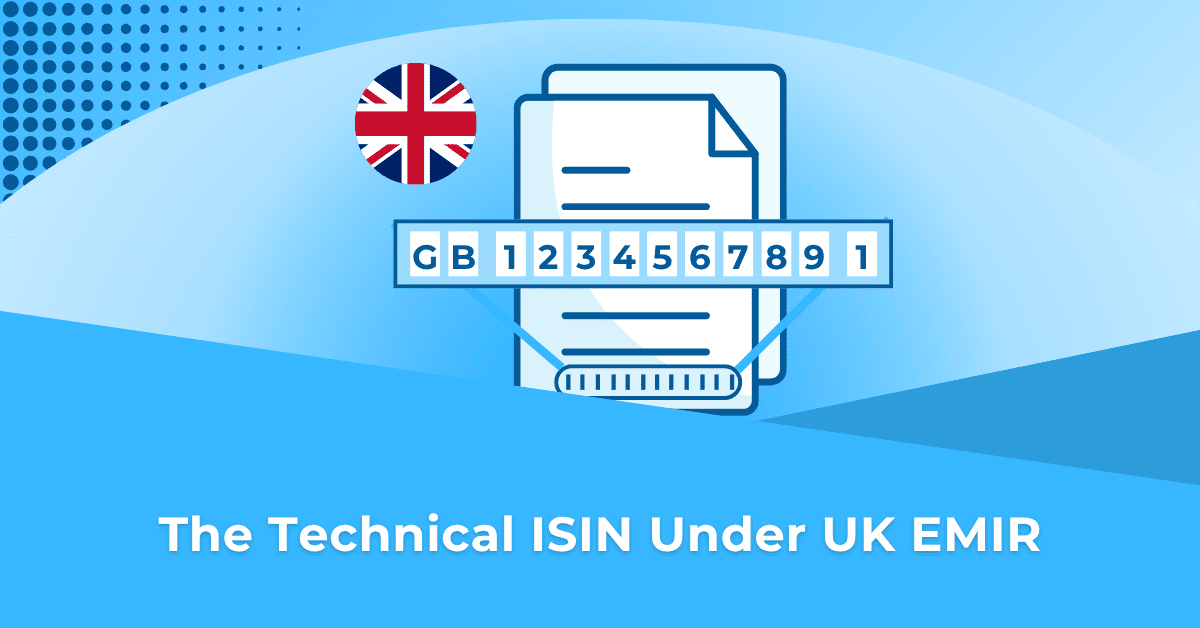
A commonly asked question by many trade reporting entities is what value to use when the underlier to the relevant instrument has no ISIN under EMIR. (An ISIN is an international securities identification number which is a product identifier code often required by trade reporting regimes).
Where no ISIN is available for equity trades or for the identifier of the relevant derivative’s basket’s constituents, then ESMA’s stated best practice is to use the ISIN for the European Financial Stability Facility. We discuss how to populate the ISIN in detail in this article. Click here to read more.
The FCA has shared its observations on the industry's performance post-Refit.
Key takeaways:
Bonds are commonly traded debt instruments, but their reportability depends on structure and where they trade. While standard bonds are not derivatives under EMIR, venue-traded bonds may be reportable under MiFIR.
TRAction looks at:
Some of the most common XML errors firms encounter under EMIR reporting include:
These issues can lead to rejected submissions, reconciliation breaks, and increased regulatory risk under EMIR Refit.
For a detailed breakdown of each error and how to resolve them, read our full article here.
video
UK Refit went live on 30 September 2024, and we’ve created a video and article highlighting the top 6 changes you need to know to stay ahead. Ensure that your firm is prepared for these major regulatory changes.
Previous Number of Fields
Increase in Fields
Fields After Refit
Years Since EMIR Came Into Law
ISO format #

Determine what you are required to report under EMIR, MiFIR, and MAS regimes with our free Assessment Tools.
Simply answer a few questions about your business and our Reporting Assistant Reggy will calculate your reporting obligations.
Get in touch with us for assistance.