
The FCA has lifted its ban on crypto Exchange-Traded Notes (ETNs) for professional investors. The relevant regulatory changes took effect on 8 October 2025. The FCA issued a press release that confirms that they will open retail access to crypto ETNs so long as they are “traded on an FCA-approved, UK-based investment exchange”. This means crypto ETNs that are traded on an FCA-recognised investment exchange are now allowed for professional investors.
So are these crypto ETNs be MiFIR reportable?
What are ETNs?
From a legal perspective, ETNs are structured as debt instruments or notes issued by financial institutions. Investors lend money to the issuer by issuing a note and the issuer promises to pay a return based on how well the asset does, which is the subject of the note. ETNs are similar to exchange traded funds (ETFs) however, ETFs are essentially funds which hold a basket of securities or assets. ETNs are notes that are classified as legally transferable securities. Both give similar returns on the same underlying asset. However, the structural differences between the two does not impact their MiFIR reportability, as they are both subject to MiFIR where they are traded on a trading venue (TOTV) or for which admission to trading on a trading venue has been requested.
What are Crypto ETNs?
Crypto ETNs are notes issued by a financial institution where the return on such asset is linked to the crypto’s (or basket of cryptos) performance. Investors do not actually own the crypto (e.g. Bitcoin or Ethereum), but rather, they hold the note, which tracks the price of the crypto.
What makes an instrument reportable under MiFIR?
Article 26(2) of MiFID II/MiFIR (for both EU and UK) provides that investment firms must report transactions in financial instruments which are:
“(a) admitted to trading or traded on a trading venue or for which a request for admission to trading has been made;
(b) financial instruments where the underlying is a financial instrument traded on a trading venue;
(c) financial instruments where the underlying is an index or a basket composed of financial instruments traded on a trading venue.”
See our flowchart below for how to determine a product’s MiFIR reportability:
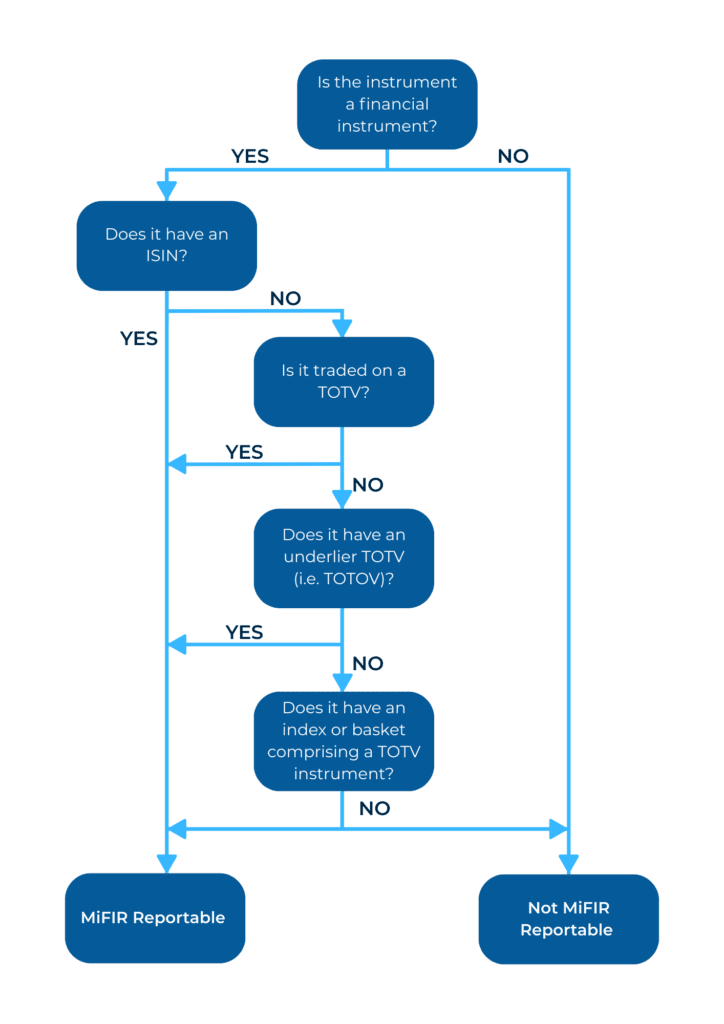
For more information on MiFIR reportability please see our FAQs page here.
Detailed analysis on MiFIR reportability
The two questions to ask in determining whether a product is reportable under MiFIR are below:
- Does the instrument have an ISIN?
The MiFIR regime requires instruments within scope to have an International Securities Identification Number (ISIN) which is essentially a product identifier code. There are also occasions where an ISIN is not available for a product but this is not determinative as to whether it is reportable under MiFIR.
ETNs are normally issued with an ISIN and this makes such instruments in scope for MiFIR transaction reporting. For more information on ISINs and MiFIR reportability please see our article here.
- Is the instrument traded on a trading venue (TOTV)?
Transactions are MiFIR reportable if the financial instrument is admitted to trading or traded on an EU/UK trading venue i.e. regulated market, multilateral trading facility or organised trading facility. This also is the case for financial instruments where the underlier is a financial instrument TOTV (referred to as TOTOV) or the underlier is an index or a basket made up of financial instruments that are TOTV. For more information on venue types and TOTVs, please see our articles here and here.
So, are Crypto ETNs MiFIR reportable?
Yes. The crypto ETNs which the FCA has approved should have ISINs and should also be listed and traded on venues. Given the MiFIR reportability criteria will be satisfied, i.e. they are:
i. ETNs (financial instruments / transferable securities); and
ii. traded on venue,
these instruments will be MiFIR reportable. This is irrespective of whether the party to the transaction is from the retail or wholesale sector.
How can TRAction assist?
If you need assistance in determining if any trade reporting regime applies to you, complying with the technical requirements or need help with your delegated trade reporting services, please contact us.