
EU/UK – How Does the End of Daylight Saving Time Impact Your Reporting?
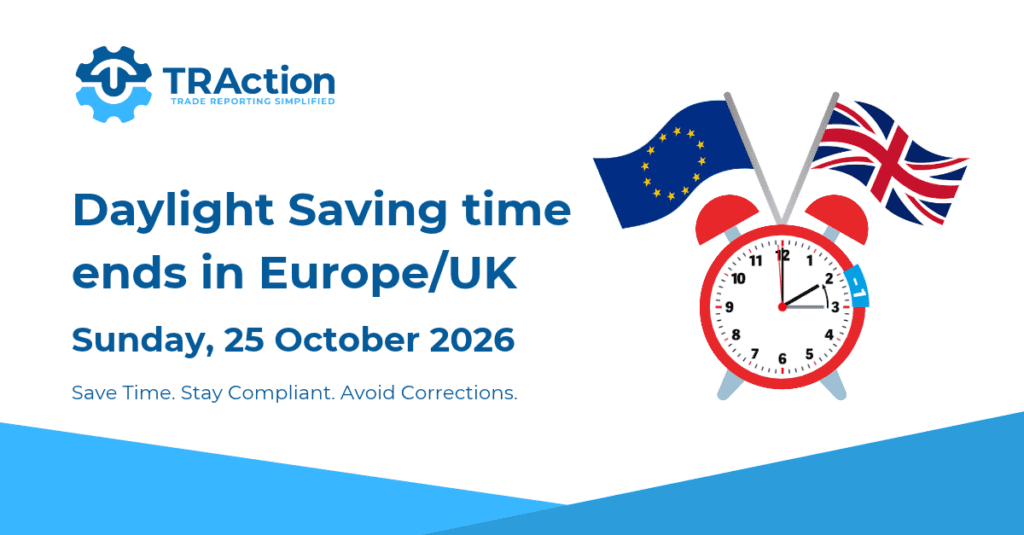
Most European countries alongside the UK will need to turn their clocks forward by 1 hour this Sunday, 31 March 2024. While you enjoy the sun and longer days, you will also need to check that the time settings in your trade/transaction reporting are correct.
Meet the team: Loukiana Protopapa

How did Loukiana find herself at TRAction? After more than 10 years working across a range of companies and building diverse experience in corporate and commercial law, Loukiana joined TRAction following her role at PwC Legal in Cyprus. Loukiana’s responsibilities in her role… As TRAction’s Legal and Regulatory Executive, Loukiana is responsible for regularly monitoring […]
FCA – Overhaul of UK Transaction Reporting Regime

The FCA has published Policy Statement PS26/15, “Improving the UK transaction reporting regime,” confirming its final rules following last year’s consultation CP25/32. The reforms mark the most significant changes to UK MiFIR transaction reporting since MiFID II. With simplification being the goal, the FCA estimates savings of more than £100 million a year for industry […]
UPIs – what information is needed to search/create a UPI?

The Unique Product Identifier (UPI) is a code used for OTC derivatives that are reported to a trade repository – their purpose is to help identify the relevant OTC derivative. UPIs are now required across EMIR, ASIC, and MAS, following the go-live of the UK and EU EMIR Refits, and the ASIC and MAS Rewrites. […]
Meet the team: Venkatesh Chennemsetty

How did Venkatesh find himself at TRAction? Before joining TRAction, Venkatesh built his career across leading global investment banks and later at global hedge fund, working across a range of roles including Business Analyst and Product Owner. Venkatesh explains “In past organisations, I worked in various different roles including Business Analyst and Product Owner, where […]
Meet the team: Akash Watpade

How did Akash find himself at TRAction? After 13 years of experience in investment banking, Akash wanted to pivot towards the operational side of finance, which led him to discovering TRAction. His front facing experience naturally translated into helping clients navigate regulatory compliance with confidence. Akash’s responsibilities in his role… Akash supports clients under the […]
The Most Common Errors in SFTR Transaction Reporting
We’ve identified the 3 most common errors in the transaction data we receive from our clients
Unique Product Identifiers – ANNA-DSB & the UPI

The Unique Product Identifier (UPI) is a new field and a component of the common data elements (CDE) which apply under EMIR, UK EMIR, ASIC and MAS.
Are Rolling Spot FX and Rolling Spot Precious Metals reportable under MiFIR?

A common question we still get asked is whether or not Rolling Spot FX and Rolling Spot Precious Metals are considered reportable under MiFIR.
The 4 Most Common Errors in MiFIR Transaction Reporting
We’ve identified the 4 most common errors in the transaction data we receive from our clients: missing customer details, duplicate transactions and incorrectly formatted dates.