
Following a joint consultation by the Financial Conduct Authority and the Bank of England, Q&A 4.14 was finalised and added to the UK EMIR Reporting Q&As. It establishes the circumstances in which the technical ISIN may be used as a placeholder identifier in derivative reports. TRAction looks at:
- what the technical ISIN is; and
- when it can be used.
What is the technical ISIN?
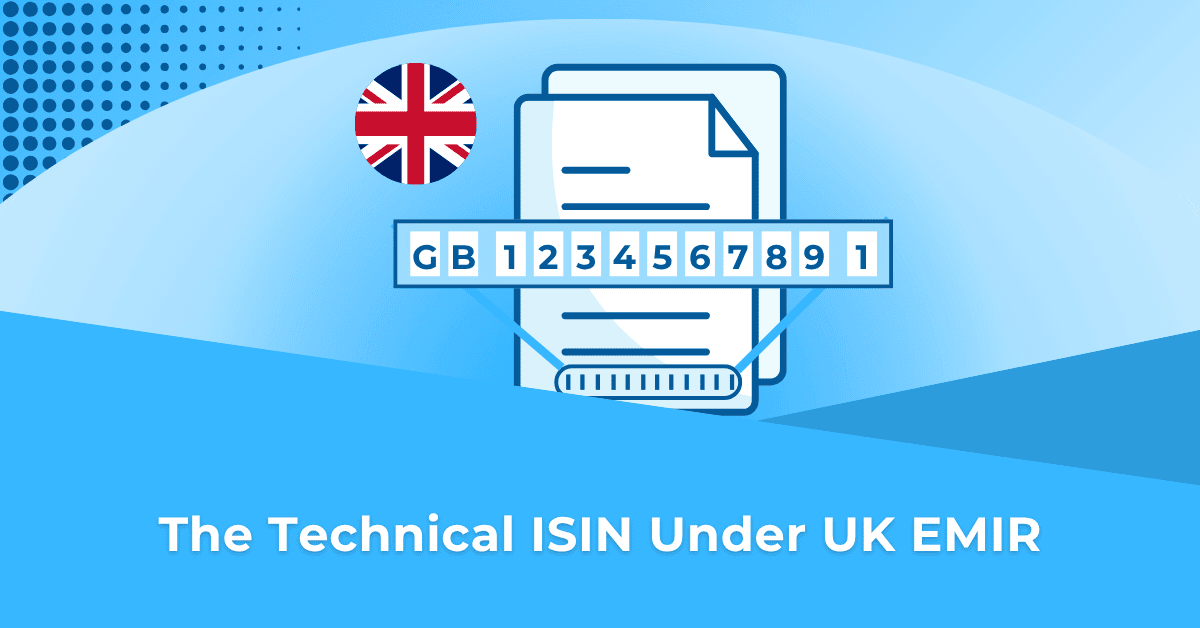
The technical ISIN is a standardised placeholder identifier introduced under UK EMIR to address situations where no standard ISIN exists for the underlying instrument of a reportable derivative contract. The technical ISIN allocated for use is GB00BRWGLN49. It provides reporting counterparties with an agreed solution for populating certain fields where an underlying identifier would otherwise be unavailable.
Why This Matters: Practical Implications for Reporting Counterparties
The introduction of the technical ISIN has a number of practical consequences for firms subject to UK EMIR reporting.
- Systems and controls updates – Firms that report derivatives referencing single stock equities from non-ISIN jurisdictions, listed futures without ISINs, pre-IPO companies, or custom baskets of non-exchange traded constituents will need to update their reporting logic to populate the relevant fields with GB00BRWGLN49 where applicable.
- Pre-IPO obligations – The obligation to update the underlying identification field with the correct ISIN post-IPO creates an ongoing monitoring requirement. Firms need processes in place to identify when a pre-IPO underlying has listed and obtain its ISIN promptly.
- Reconciliation implications – Because the technical ISIN is a standardised placeholder, counterparties reporting the same trade should use it consistently in the same fields. Inconsistent use could generate reconciliation breaks, which entities responsible for reporting are required to remediate as soon as practicable.
The Problem: UK EMIR and the Missing Identifiers for Underlying Instruments
UK EMIR requires counterparties to report the details of any derivative contract they conclude, modify or terminate to a registered or recognised trade repository. The reporting obligation applies to both over-the-counter derivatives and exchange-traded derivatives. ISINs must be used where the derivative is:
- admitted to trading or traded on a trading venue (TOTV), or
- traded on a systematic internaliser where the underlying is admitted to trading or TOTV, or
- an index or basket of instruments TOTV.
The ISIN relates to the derivative contract being reported. Separately, counterparties must also report an identifier for the underlying of that derivative (i.e. the stock, future, index or basket to which the derivative is referenced).
This creates a practical problem. When the underlying instrument is, for example, a single stock equity listed in a jurisdiction that does not mandate the issuance of ISINs, or a company that has not yet completed an initial public offering, no standard ISIN exists. Similarly, where a bespoke basket contains constituents that are not traded on any trading venue and have no ISINs, the ‘Underlying identification’ field (Table 2, Item 14) and the ‘identifier of the basket’s constituents’ field (Table 2, Item 18) cannot be populated.
Prior to Q&A 4.14, reporting counterparties had no agreed solution to these cases. The introduction of the technical ISIN addresses this gap.
Q&A 4.14: When Is It Acceptable to Report with a Technical ISIN?
Q&A 4.14 was finalised in the UK EMIR Reporting Q&As following the conclusion of the joint FCA/BoE consultation.
According to the Q&A, the technical ISIN can be used to populate the following fields in the specified scenarios only:
1. ‘Underlying identification’ field (Table 2, Item 14)
- If a single stock equity that is the underlying of a reportable derivative transaction is issued in a region that does not mandate the use of an ISIN, and no ISIN is available.
- If a listed future that is the underlying of a reportable derivative transaction is issued in a region that does not mandate the use of an ISIN, and no ISIN is available.
- If a pre-IPO single stock equity is the underlying of a reportable derivative transaction. This field should be updated with the relevant ISIN as soon as it becomes available, post-IPO.
2. ‘Identifier of the basket’s constituents’ field (Table 2, Item 18)
- If a custom basket of a reportable derivative transaction is composed entirely of constituents that are either not traded on a trading venue or do not have an available ISIN (for the reasons mentioned in 1. above).
The technical ISIN must never be used to populate the ‘ISIN’ field (Table 2, Item 7). The ‘ISIN’ field records the identifier of the derivative contract itself, not the underlying. Where no product identifier exists for a derivative executed on a third-country organised trading platform, no identifier needs to be reported. The technical ISIN is not a substitute and should not be used as a general-purpose placeholder for any field where an ISIN is unavailable.
Conclusion
The introduction of the technical ISIN reflects the regulators’ ongoing effort to ensure that UK EMIR reporting data is complete, accurate and consistent. Firms, however, must apply it only in the prescribed scenarios, maintain processes to replace it with the correct ISIN where circumstances change and treat it as a temporary accommodation rather than a permanent fix.
How can TRAction assist?
If you need assistance in understanding the scope and application of the technical ISIN, please get in touch with us.