

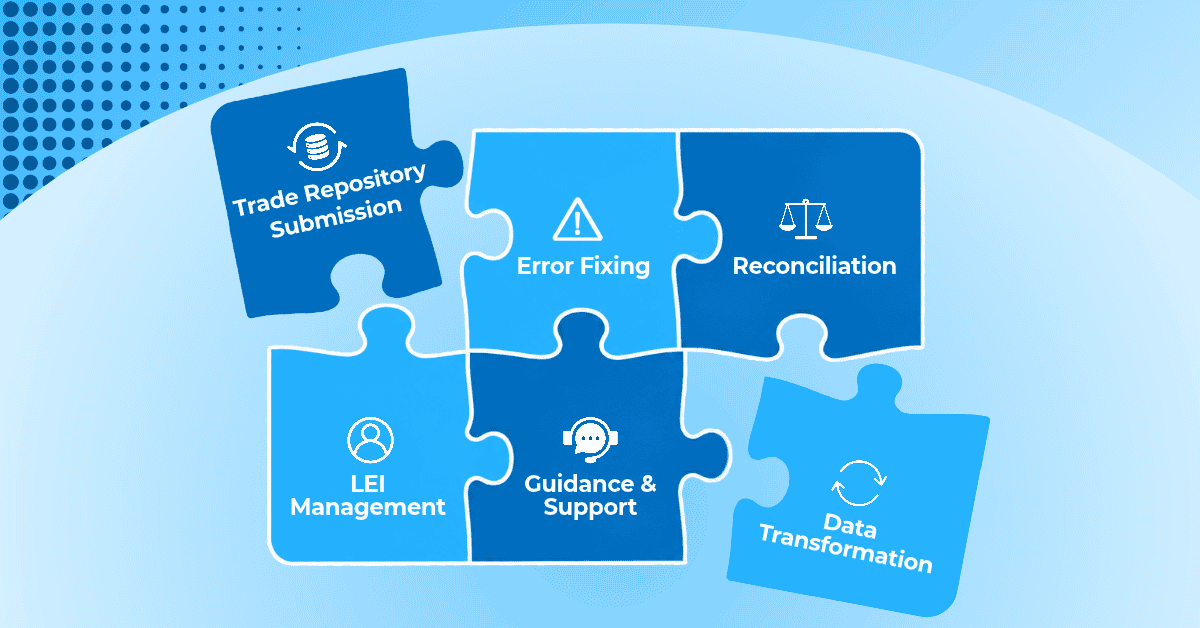
Trade reporting is a constant challenge for compliance and operations teams. For many firms, it can feel like a never-ending puzzle. Challenges like regulatory complexity, evolving requirements, reconciliations, data transformation, and ongoing error management make it easy to feel like you’re missing a crucial piece.
Firms without a dedicated reporting function often patch together manual processes or outsource to vendors that only seem to cover one piece of the puzzle. Mismatched data, friction, and inconsistent systems that don’t talk to each other, lead to fragmented reports that break at submission, making it difficult to report accurately and consistently.
The cost of this fragmentation is significant. In its Consultation Paper CP25/32, the FCA acknowledged that meeting MiFIR transaction reporting requirements places a high cost on firms. Industry responses to the FCA’s earlier Discussion Paper (DP24/2) went further. They highlighted that the burden is not only financial but is also measured in people, time and systems.
Instead, firms should consider a single, integrated solution interlinking each piece to meet trade reporting obligations as a whole. At TRAction, our solution is simple. We complete the trade reporting puzzle with six connected core pieces:
- Trade repository submissions
- Reconciliation
- Data transformation
- Error fixing
- Guidance and support
- LEI management
Below, we consider each piece and what firms should evaluate to meet their trade reporting obligations.
1. Trade Repository Submissions
Reports must reach the right trade repository (TR) in the correct format, on time, every time. This involves capturing, processing, validating, and transmitting trade data within the deadline set by each regime.
Accurate submissions rely on solid LEI management, reconciliation, error fixing, and data transformation processes, with the right guidance, for a complete solution to trade reporting. Without consistent data, correct LEIs, diligent error/exception management, and up-to-date expertise, submissions can end up late or inaccurate, resulting in rejections, reconciliation breaks and, ultimately, into penalties and fines for missed obligations.
TRAction’s end-to-end solution manages regulatory submissions on behalf of firms obligated to EMIR, MiFIR, SFTR, ASIC, MAS, Canada regimes and more. This includes a secure portal access for firms (and their clients) to upload and download trade and confirmation files, ensuring visibility, transparency, and feedback for submissions reported on their behalf.
2. Recconciliation
To maintain accuracy and prevent discrepancies, firms should regularly reconcile their internal trade records against the data held by the TR, to confirm that every reportable trade has been reported and that the reported details are accurate and up to date. Under dual-sided regimes such as EMIR, TRs also reconcile the reports submitted by both counterparties. Any unpaired or unmatched trades need to be investigated and resolved. Without a dedicated reconciliation system, many firms perform this manually, exposing the process to human error. For firms with high trade volumes, this can be particularly time-consuming to execute and monitor.
TRAction specialises in trade reporting completeness, reconciling TR records against firm records to identify and resolve differences between the two data sets. With a team of experts in financial products, compliance/legal and IT, we simplify the process for our clients by comparing and tracking open positions as part of our service, so that discrepancies are identified and corrected.
3. Data Transformation
The backbone of any successful trade report is accurate data – both correct in substance and correctly formatted. Data transformation maps, cleans, and standardises trade data, converting raw internal data such as dates, currencies, country codes, and UPIs into the correct formats that match TR requirements and the regulator’s schema.
Gathering, validating, and submitting enormous volumes of data can be a laborious and complex operation.
At TRAction, we customise our solution for each client’s situation in order to automatically collect and transform data directly from their preferred trading platform. By enriching and converting data, we provide field-by-field mapping of internal trade data designed to pass TR validations. Our solution’s technology framework drastically reduces manual work and lowers the risk of errors, enhancing data accuracy while saving firms internal costs on trade capture systems.
4. Error Fixing
Reporting errors take two forms: reports rejected by the TR for failing validation, and reports that are accepted but contain inaccurate or incomplete data. If repeated or left unresolved, either can attract regulatory scrutiny and sanctions, including fines. Error fixing identifies and corrects these exceptions.
TRAction don’t pass errors back to our clients. Instead, we’ve designed our internal platform to detect and reduce the risk of any errors occurring in the first place, ensuring that exceptions are corrected on behalf of the firm before returning confirmation files. Where client input is needed, such as missing or incorrect static data, we flag it early and work with the firm to resolve it. Fixing errors is managed by TRAction rather than being passed back to the firm to rectify themselves or at an extra charge.
There are a number of regime-specific reporting errors that are common but easily avoidable. We share resources outlining these on our blog.
5. Guidance and Support
Trade reporting requirements are subject to ongoing change. Rules are amended, jurisdictions introduce new obligations, and reporting standards are regularly revised. Recent years have seen major rewrites of the EU and UK EMIR, ASIC, MAS and Canadian reporting rules, with further changes, including those following the MiFIR review, still to come. For firms without a dedicated compliance function, monitoring this pace of change is difficult.
Compliance sits alongside core business operations rather than in front of them, and the resourcing to track an ever-evolving regulatory landscape is often not there. It is easy for firms to lose visibility over which requirements have changed, causing greater room for error when reporting processes are based on outdated requirements, ultimately being costly to identify and time consuming to correct.
Maintaining current regulatory knowledge is a core part of TRAction’s operating model. With more than 11 years of industry experience and a dedicated team, focused exclusively on trade reporting, we ensure accurate identification and management of firms’ regulatory blind spots and monitor regulatory developments as they emerge. Our support is available 24 hours a day, 5 days a week, ensuring firms can access accurate and up-to-date guidance when they need it.
6. LEI Management
Many firms find the renewal process complicated and time-consuming. However, a lapsed, inactive LEI can quietly break a reporting pipeline resulting in more work than necessary to rectify. Maintaining and managing LEIs is part of TRAction’s all-in-one solution, taking the burden away from firms by lodging initial LEI applications and handling annual renewals.
Legal Entity Identifiers (LEIs) are unique 20-digit alphanumeric codes that enable clear and unique identification of legal entities participating in financial transactions. Every reporting entity needs a valid LEI to engage in financial market transactions, but among a number of daily trades and core business operations, LEI management becomes an easy piece to overlook.
Where required, we extend LEI management assistance to the delegated clients of the firms we support, further mitigating scenarios where lapsed LEIs prevent timely submissions. By managing yearly renewals, TRAction streamlines processes and further reduces the workload for compliance teams.
Why Reporting Shouldn’t Be Fragmented
Trade reporting is not a single task but a series of interdependent systems, each carrying its own risk if left unmanaged. Firms that address these pieces in isolation expose themselves to a fragmentation that affects the entire trade reporting puzzle.
Industry feedback to the FCA pointed to:
- People: full-time staff dedicated to reporting, with headcount growing in line with the size of the firm.
- Implementation: technology builds, consultancy, staff training and onboarding.
- Third-party providers: fees for reporting mechanisms such as ARMs, often scaling with trading volume, alongside separate reference data subscriptions.
- Maintenance: ongoing software updates and integrations to keep trading and reporting systems aligned with changing requirements.
- Time: recurring hours every month spent on submissions, reconciliations and correcting errors.
By consolidating these functions into one solution, firms remove the gaps and friction that arise between disconnected processes and providers. Fewer rejections and reporting delays ultimately free up internal teams, allowing them to focus on the core activities that matter most to the business.
How Can TRAction Assist?
Our complete, end-to-end solution connects all pieces of the trade reporting puzzle, delivered by the same dedicated team across one API-driven platform to help simplify trade reporting for firms subject to the EMIR, MiFIR, SFTR, ASIC, MAS and Canadian regimes, and beyond.
If you think your firm could benefit from a simple, straightforward solution to trade reporting, please get in touch with us.
